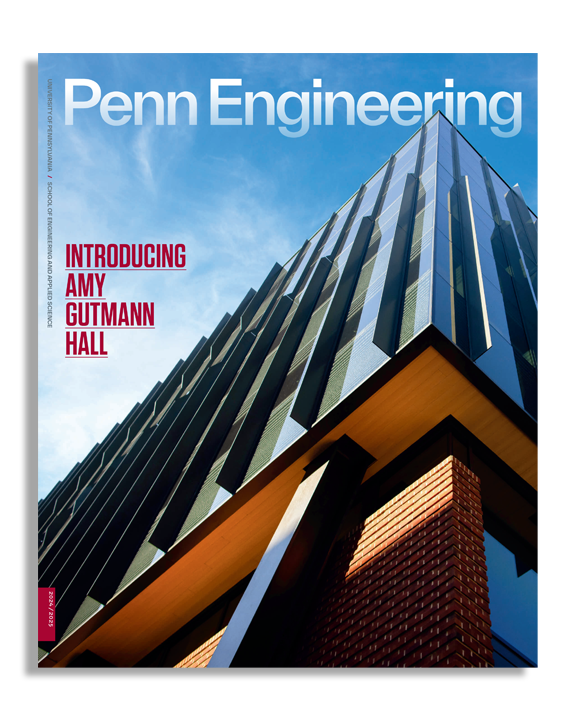
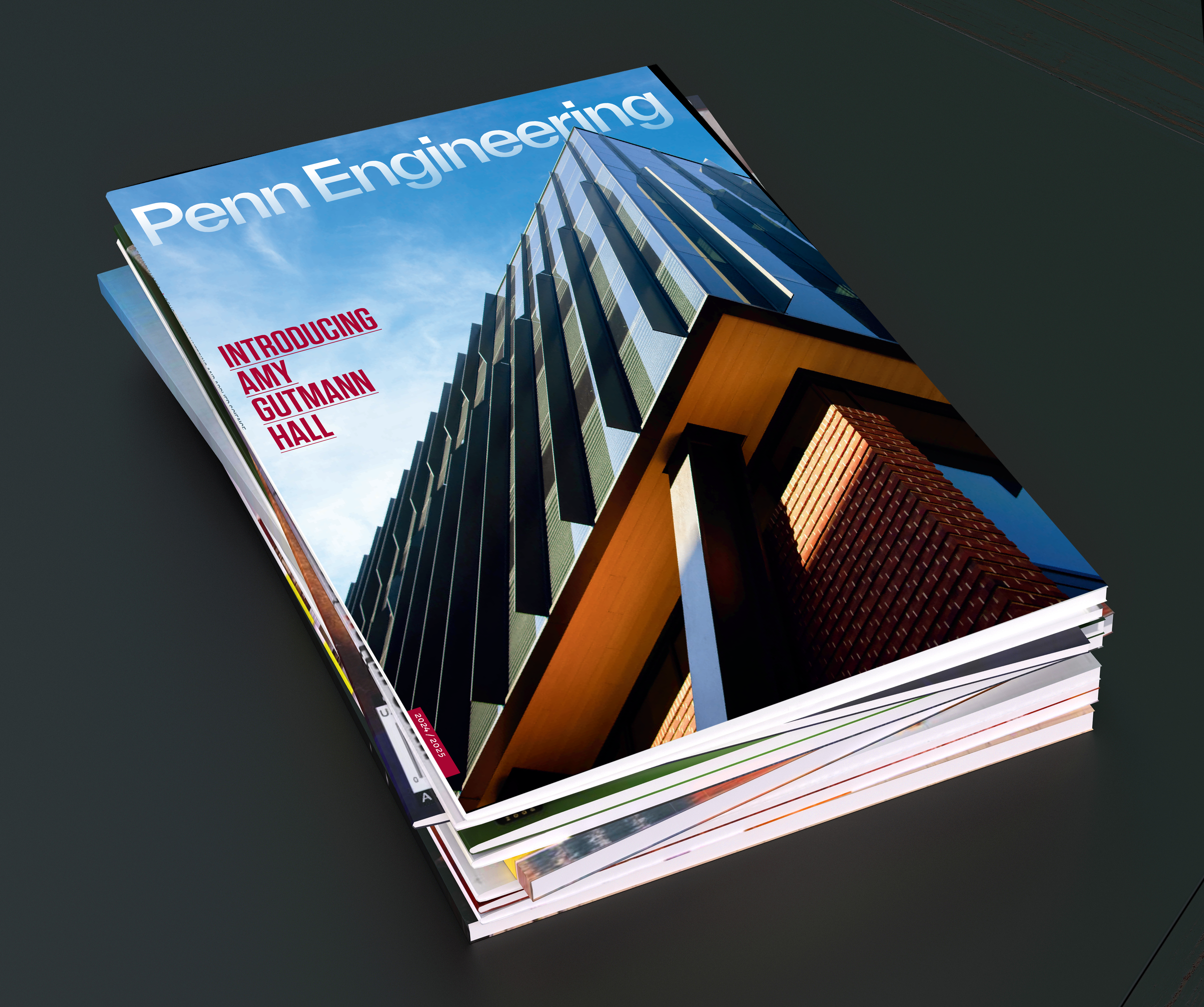
Penn Engineering Magazine

2024-2025 Issue

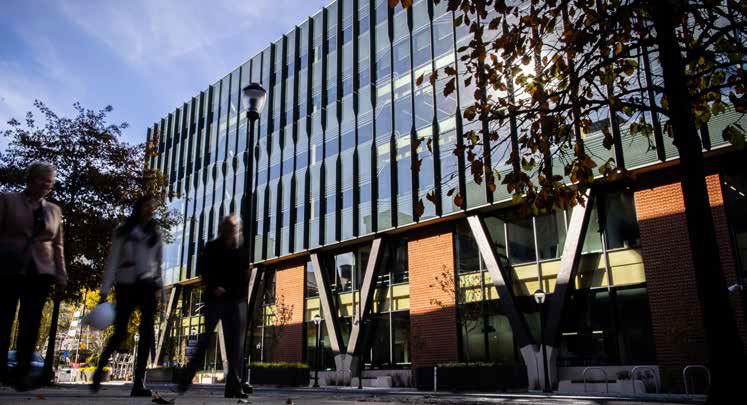
Photo of the Exterior of Amy Gutmann Hall. Photo by Eric Sucar.

Introducing Amy Gutmann Hall

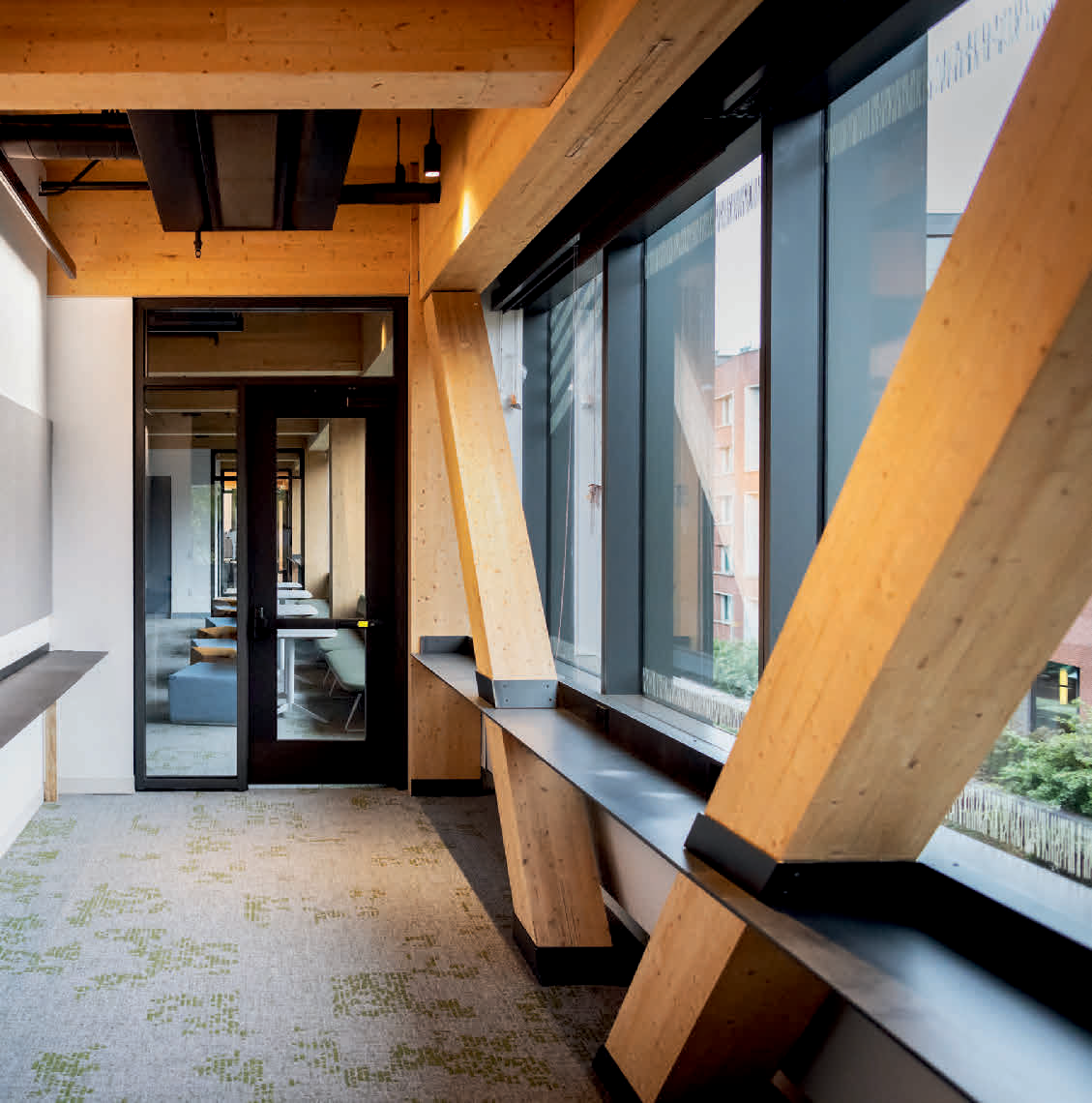
With its next-generation hybrid classrooms and labs, Penn Engineering’s Amy Gutmann Hall will fuel innovative teaching and research in AI and data science, advance the University’s reputation and attract top talent to Penn, accelerating the work of scholars across diverse fields while making the tools and concepts of AI and data science more accessible.

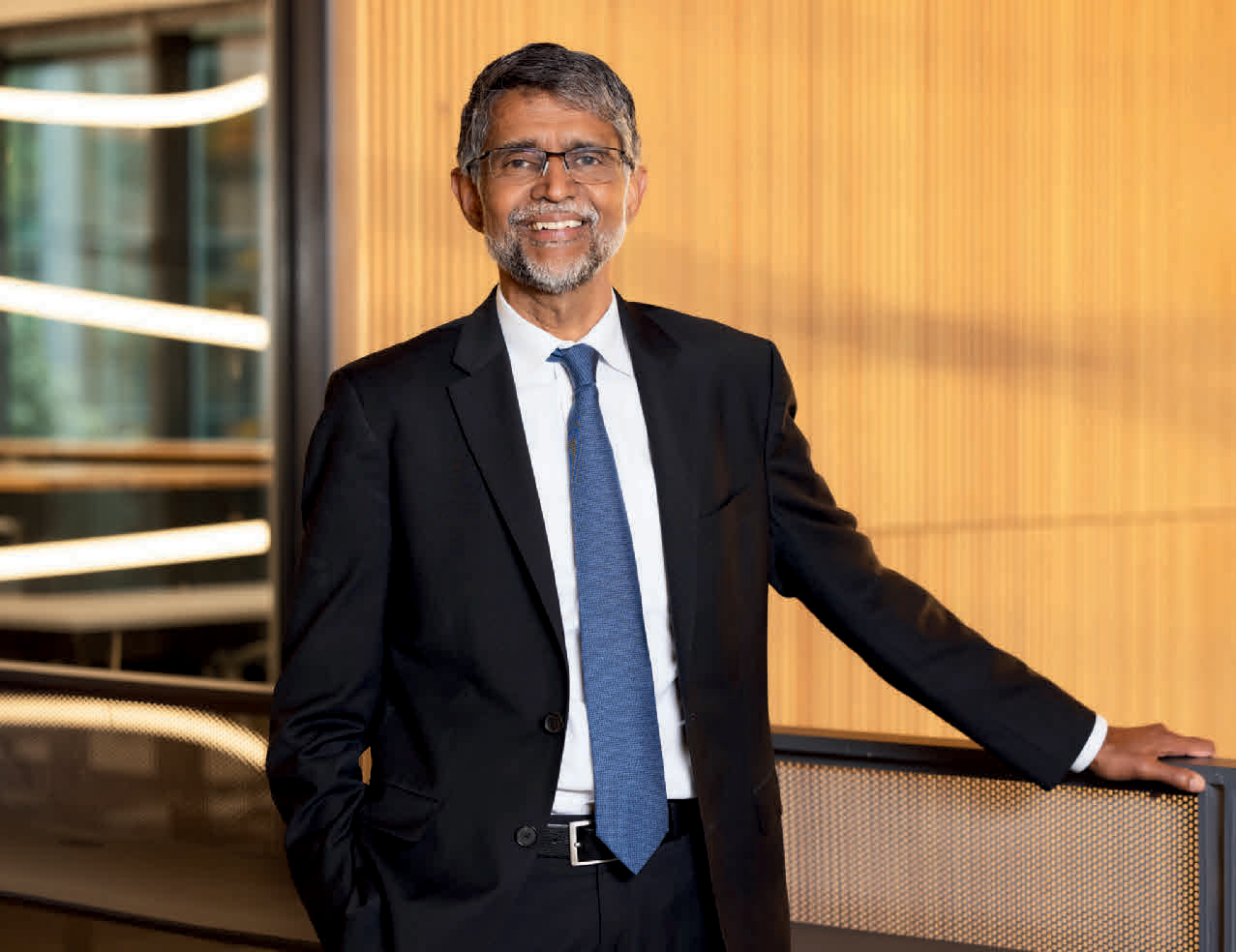
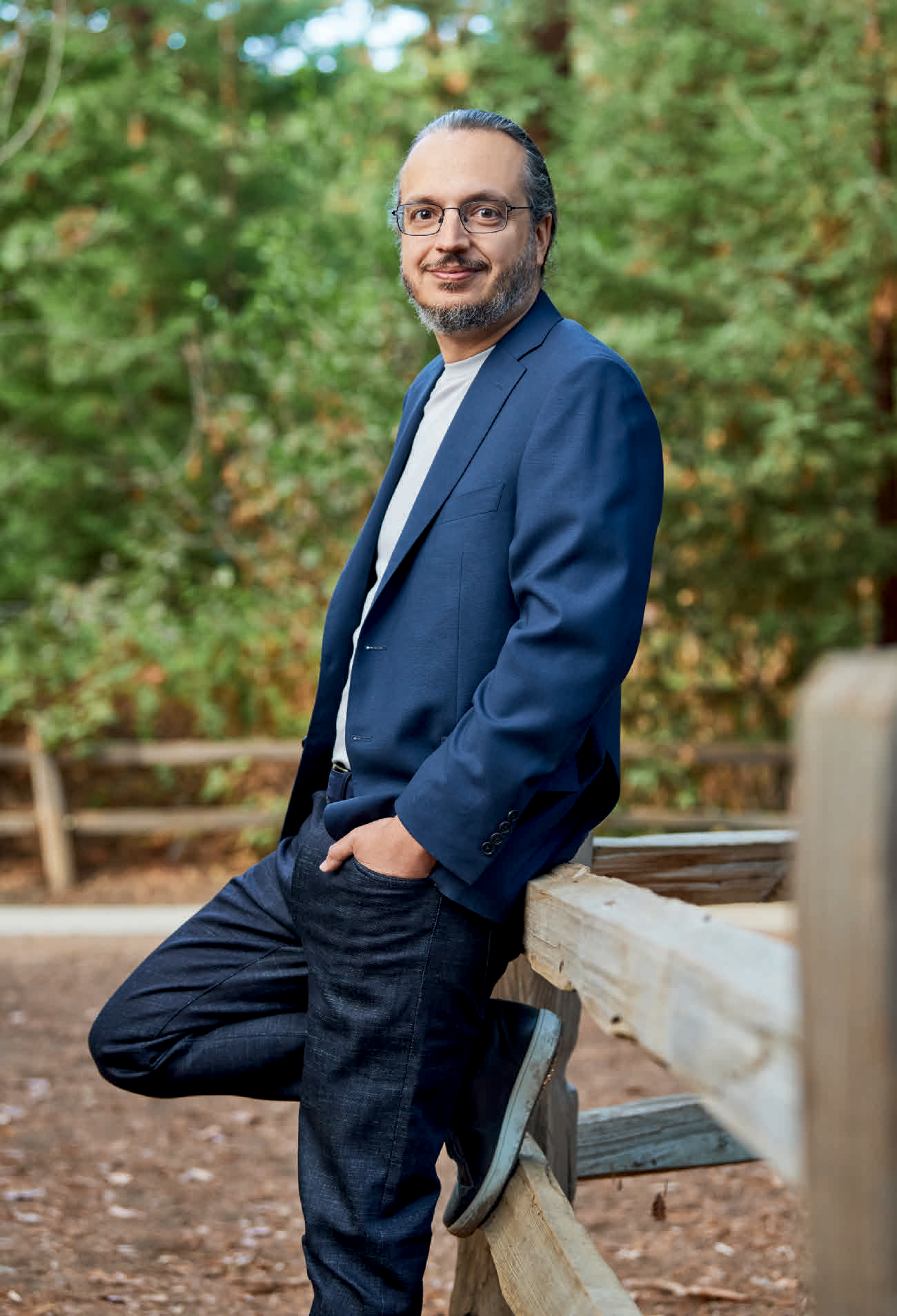
Image of Dean Vijay Kumar on Smith Walk.

From the Dean: Engineering as Optimism

Back in May, I told the Class of 2024 that “to be an engineer is to be an optimist.” There are many challenges faced by humanity, but I remain a dedicated optimist when it comes to the ability of engineers (especially our Penn Engineers!) to meet and overcome grand challenges, including human health, climate change and the responsible implementation of artificial intelligence (AI).
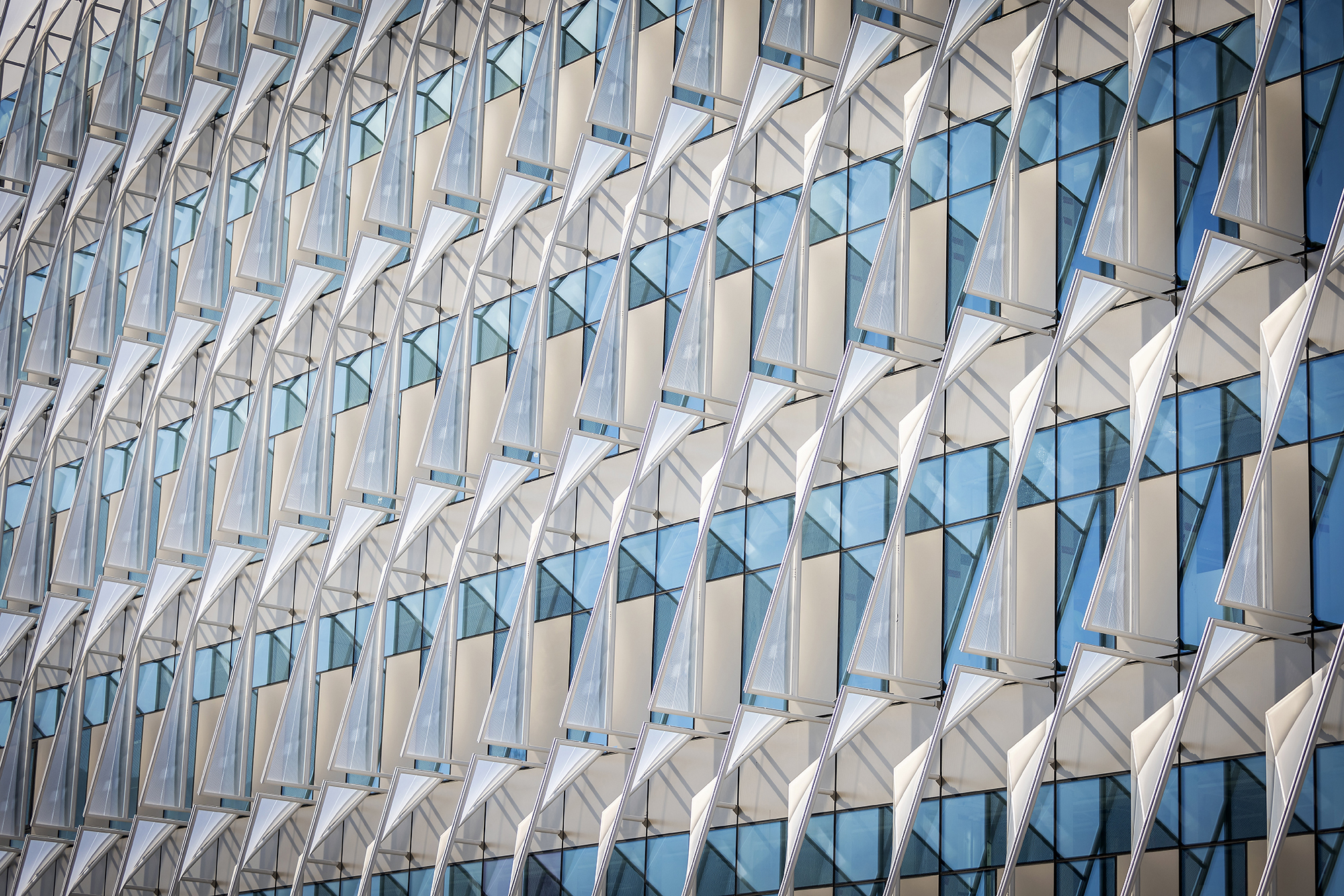
Sun shades on the VLEST. Photo by Eric Sucar.

The Big Picture: What Is This?

A microscopic surface? An AI-generated image? A series of fun-house mirrors? Wrong. This is a close-up view of the sun shades on the facade of the new Vagelos Laboratory for Energy Science and Technology (VLEST), located on Penn’s campus at 32nd and Walnut Streets.
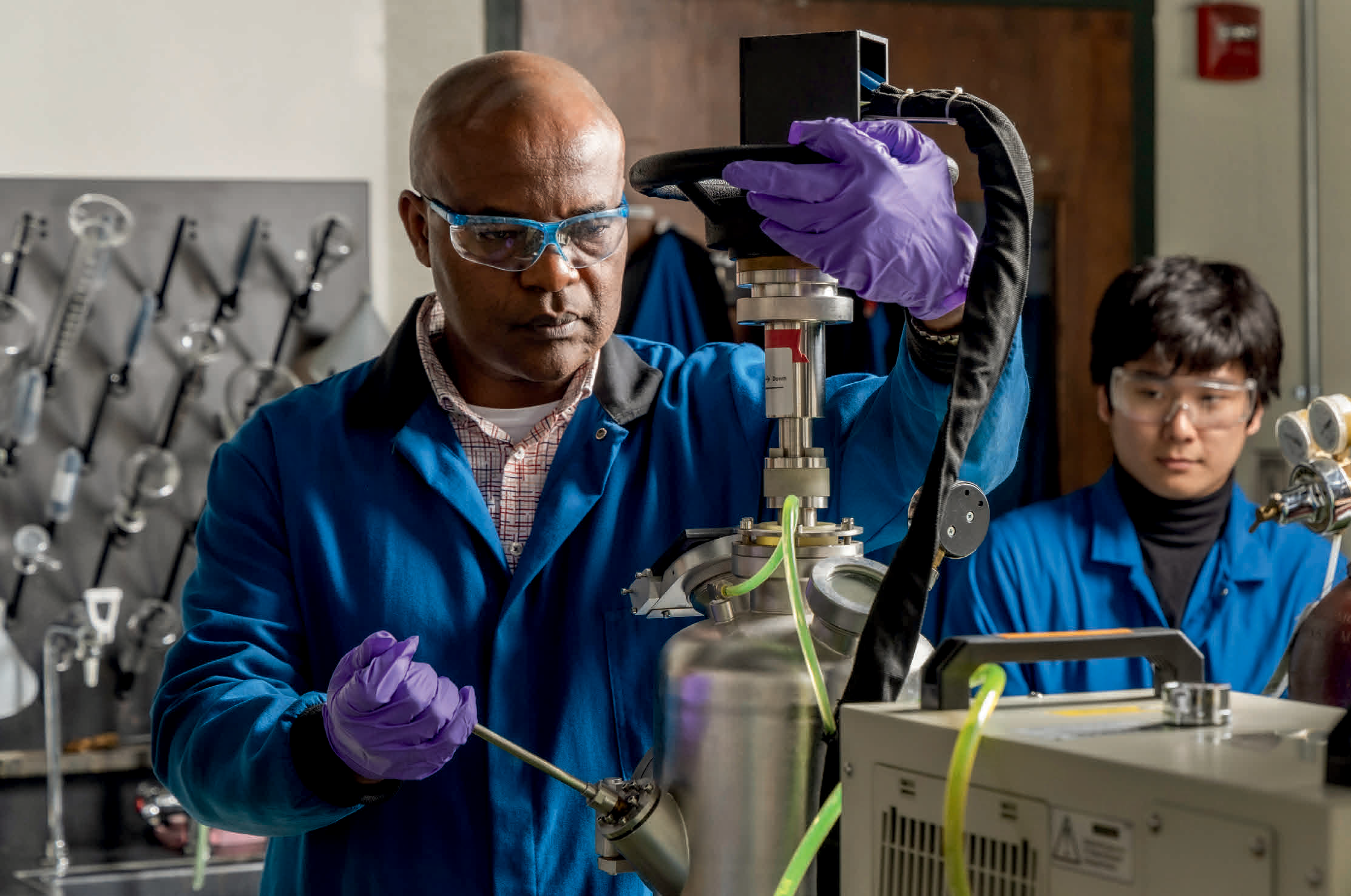
Photo of Eric Detsi and student in his lab. Photo by Kevin Monko.

Breakthroughs: Self-Healing Batteries + More

One of the greatest challenges in the fight against climate change is energy storage. Fossil fuel essentially stores itself, with its energy locked inside its own chemical bonds. But how do you store more sustainable, but otherwise ephemeral, forms of energy, like the power of the wind and sun?

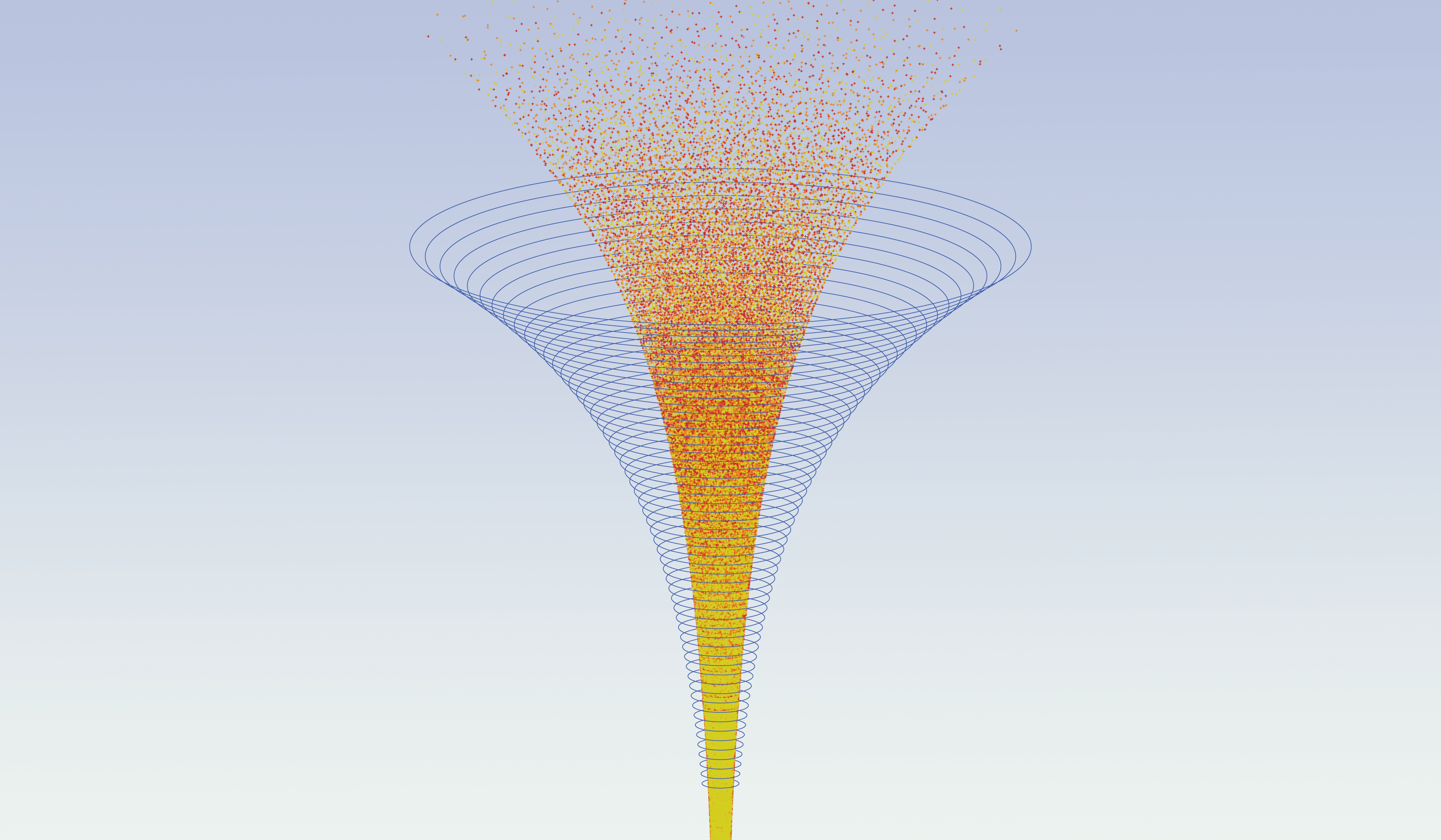
Illustration to accompany Moore's Law piece. Illustration by Michael Artman.

In Question: Is Moore’s Law Really Dead?

In 1965, Gordon Moore defined a relationship between cadence and cost for computing innovation that came to be known as “Moore’s Law.” This rule both described and inspired the exponential growth that built the Information Age. We’ve come to expect rapid improvements in technology. But can Moore’s Law go on forever?
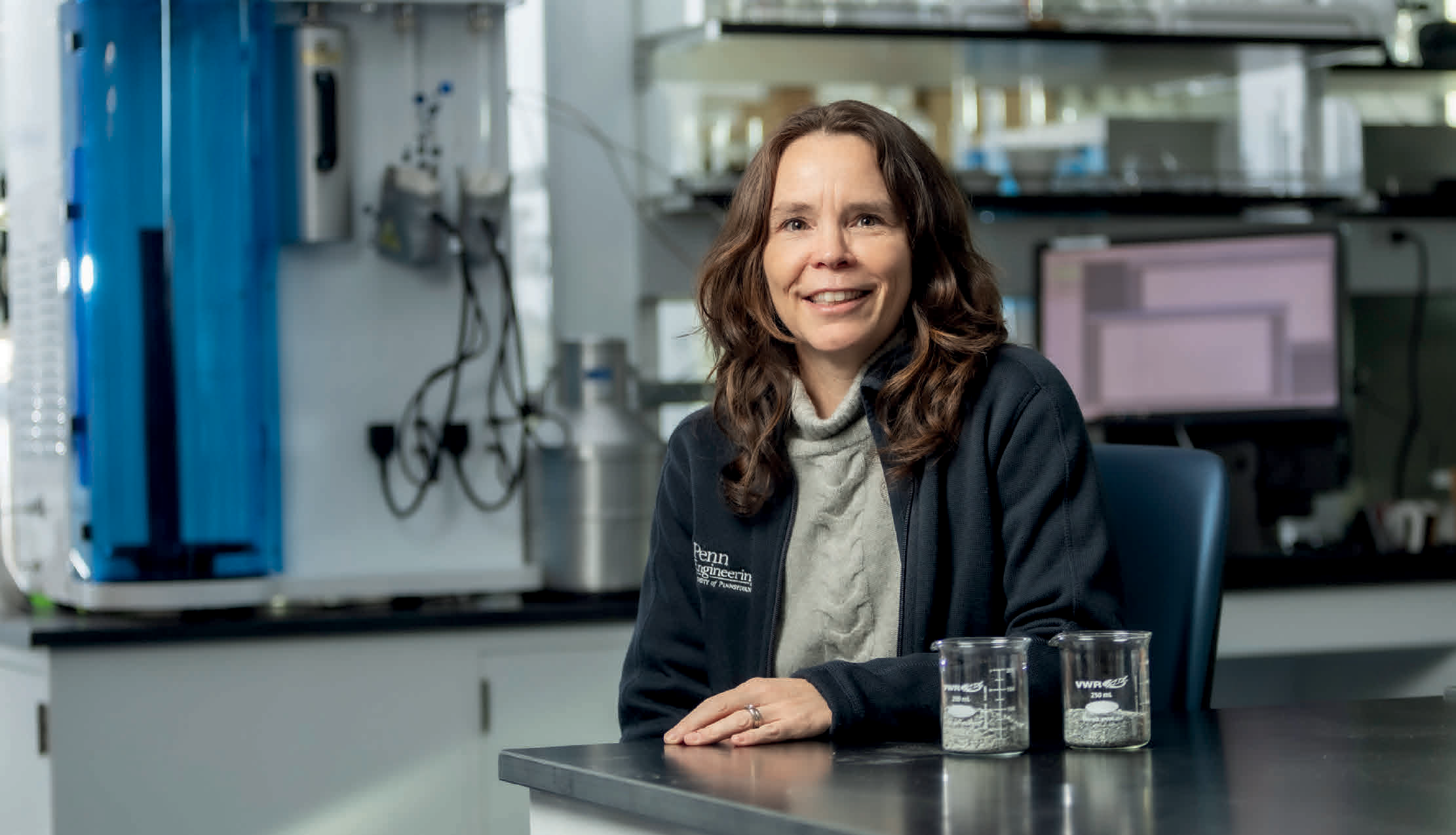
Photo of Jennifer Wilcox in her lab. Photo by Kevin Monko.

In Practice: Building a Clean Energy Future

The amount of carbon dioxide in Earth’s atmosphere reached an all-time high this May, and odds are, 2024 will rank as the warmest year on record. Climate intervention requires more than lowering greenhouse gas emissions, we also need to remove the carbon dioxide that is already in the atmosphere. Jennifer Wilcox and her team at Penn’s Clean Energy Conversions Lab are finding ways to do just that.

Photo of Michelle Parker, courtesy of Boeing.

Beyond Earth: Michelle Parker (GEN’93, GR’00)

Michelle Parker (GEN’93, GR’00) has always been interested in space exploration. After a high school physics class opened her eyes to the idea that “you can describe the universe with mathematics,” she decided she, too, wanted to be an engineer. Ultimately, the choice led her to a job at Boeing, and an up-close view of spacecraft liftoffs.

Illustration for feature on Flavia Vitale. Illustration by Matt Chinworth.

Stopping Seizures Before They Start

Neurological disorders such as epilepsy, Alzheimer’s, Parkinson’s and certain forms of dementia are the leading cause of disability and the second-leading cause of disease worldwide. The need to address neurological disorders is high, yet current diagnostics and treatments are not effective, accessible or affordable enough. Flavia Vitale, Associate Professor, is working to change that.

Photo of Matt Fallon Swimming. Photo by Sarah Stier/Getty Images.

Engineering an Olympian

The odds of becoming an Olympian are about 0.0015%. It’s hard to get into Penn — the Class of 2027 had a 5.8% admit rate — but it’s about 3,800 times harder to become an Olympian, which makes it all the more awe-inspiring that Matt Fallon (CIS’25, W’25) has done both.

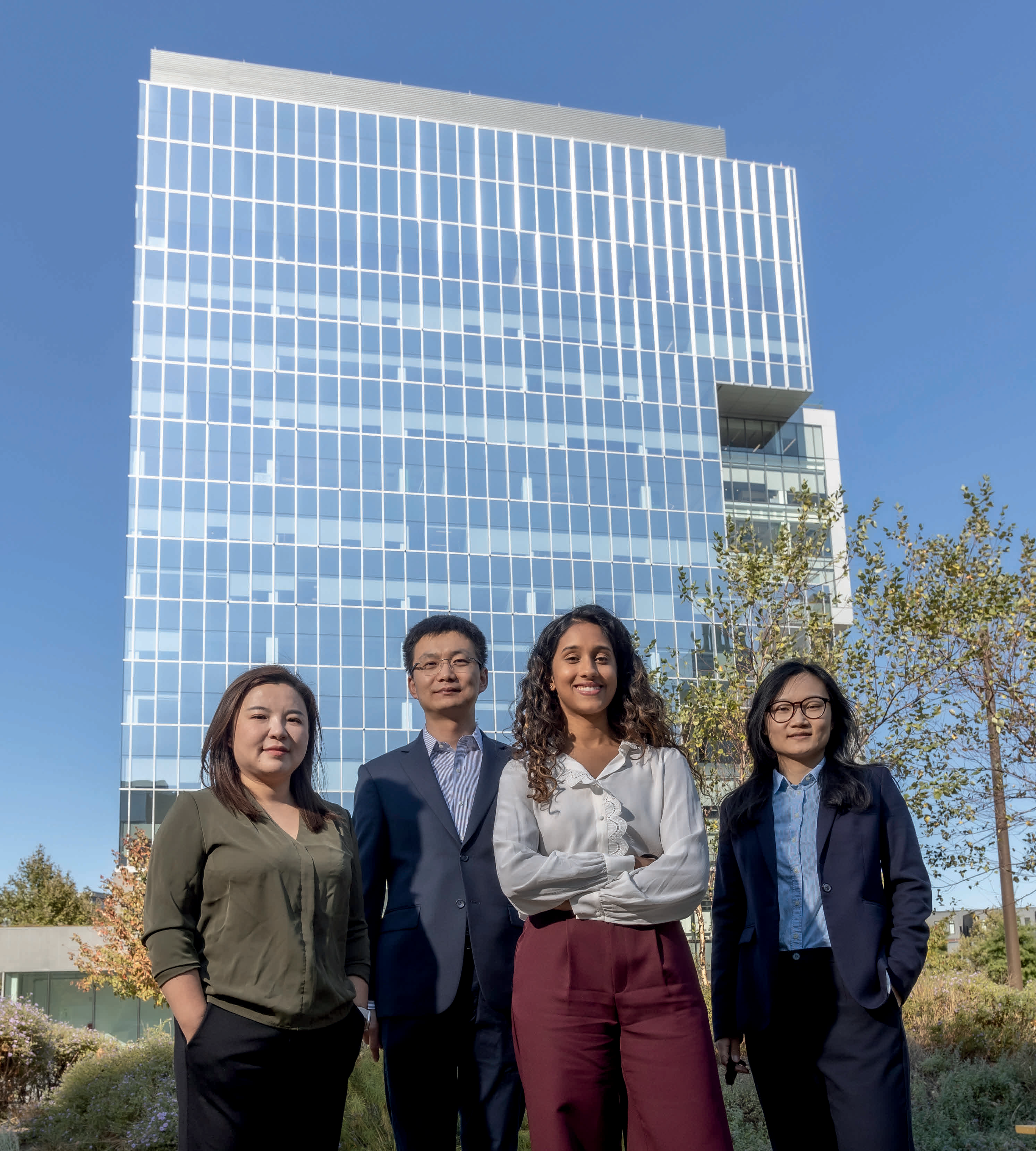
Photo of CPE4H faculty outside of One uCity. Photo by Kevin Monko.

On Our Camera Roll: Welcome to CPE4H

Penn Engineering’s Center for Precision Engineering for Health (CPE4H), housed in One uCity Square, a new 13-story, 400,000-square-foot building located on 38th Street across from Penn Presbyterian Medical Center, welcomed four new core faculty members to campus this year.
Abstract graphic of AI.

School News 2024

Penn Engineering’s 2024-25 News captures a milestone year, from the opening of Amy Gutmann Hall to the new $18M NSF AIRFoundry to Revolutionize RNA Research, to $13.5M from DARPA to enhance national computer security, and the launch of Penn Engineering’s Responsible Innovation initiative.

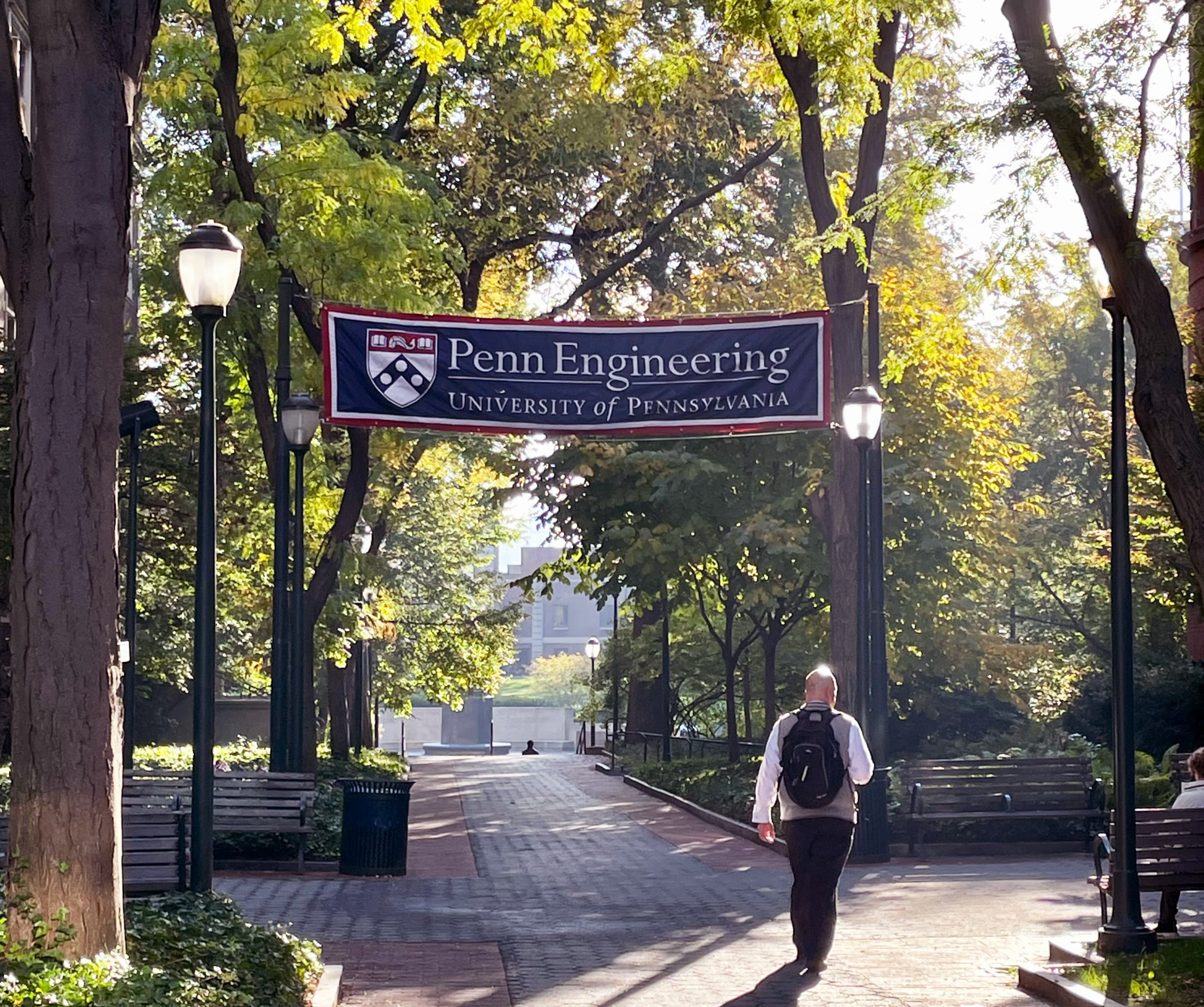
Towne Building with banner over Smith Walk

New Faculty 2024

Over the last year, Penn Engineering welcomed 15 new faculty across Bioengineering, Chemical and Biomolecular Engineering, Computer and Information Science, Electrical and Systems Engineering, Materials Science and Engineering, and Mechanical Engineering and Applied Mechanics.

In Memoriam

In Memoriam 2024

Remembering Charles D. Graham, Professor Emeritus in Materials Science and Engineering, and Solomon R. Pollack, Professor Emeritus in Bioengineering.

Cropped featured image of Alexander Paul Carobus

Why I Give: Alexander Paul Carobus (ENG’99, C’99)

In high school, Alexander Carobus (ENG’99, C’99) discovered a passion for computer games that developed into a deep interest in computers and eventually led him to pursue a bachelor’s degree in Computer Science from Penn Engineering.

Power the Next Breakthrough

Every day, Penn Engineers push the boundaries of what’s possible. Support through Penn Engineering Annual Giving sustains the research, teaching and collaborations that lead to real-world solutions and a better future.